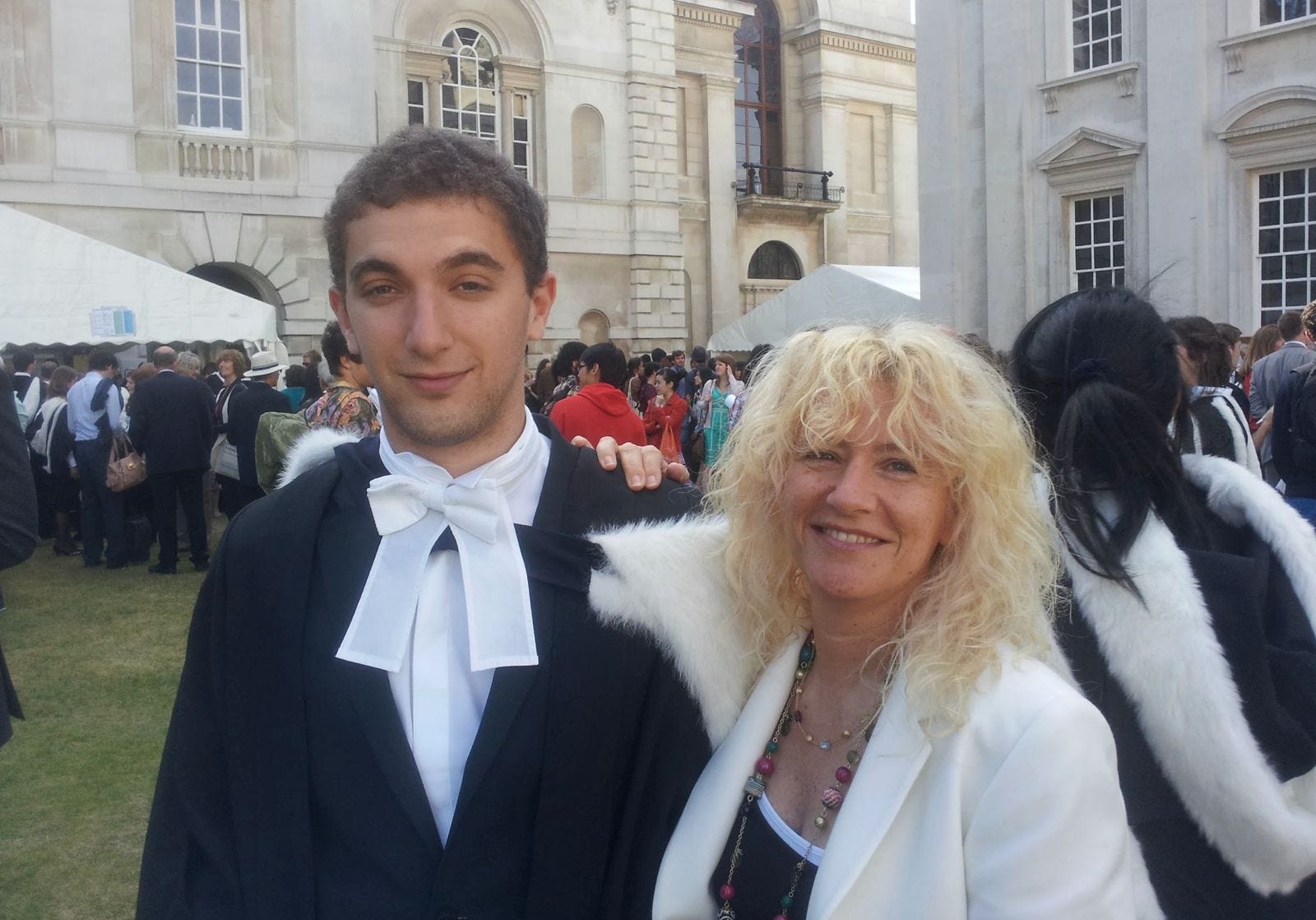
I studied in the academic department at Cambridge that later employed Jason Arday.
My degree was in “Politics, Psychology and Sociology”. One of my papers, on the Sociology of Education, was taught jointly with the Faculty of Education. It was that faculty that later employed Jason Arday, who became a professor of Sociology of Education after I graduated in 2012. All these faculties sit within the School of Humanities and Social Sciences.
I want to give a few examples of the scale of progressive ideological capture at the university even when I was a student, pre-Peak Woke, as well as illustrating the sheer intellectual bankruptcy of so much of what gets passed off as chin-rubbingly profound academic scholarship at some of the most elite educational institutions in the world.
Where to begin?
For one module, I wrote a lengthy essay about how cultural products like kids’ cartoons and jazz songs serve as instruments of capitalist oppression. I got a top mark on that paper (despite knowing at the time that I was essentially regurgitating complete crap).
While studying for another paper I had a debate with the professor, an eminent anthropologist, because she insisted we should believe and not question native tribes’ claims that they could do things like perform magic or fly through the air. After all, who are we to question “indigenous ways of knowing”?
An anthropology professor insisted we should believe and not question native tribes’ claims that they could do things like fly through the air.
For a different course, I read long “research papers” which argued that the fact that black kids are excluded from schools more than white kids proves systemic racism exists in education. Crucially, they ignored the fact that white kids are excluded more than, e.g. Japanese kids, a statistic which, applying the exact same logic, would suggest that the education system is systemically biased in favor of, erm, Japanese kids.
Something that was held up as proof of the existence of this largely imaginary racism was that teachers tell kids not to use booming voices in the classroom, and not to put up their hoods or wear their trousers down below their underpants.
On another occasion, my supervisor casually praised some student agitators who were trying to shut down a talk by someone they disagreed with. I said that I didn’t think this was something to celebrate, because I believed in freedom of speech. He got visibly angry, and proceeded to tell me that free speech was not worth protecting in a capitalist system (or something along those lines).
In my all-important final year, a lecturer let me know that I shouldn’t worry too much about my exam results, because, as someone who was not from an upper class background, I should be more focused on using my grasp of leftist revolutionary theory to further the interests of the proletariat. Writing this down, it strikes me that it’s so hilariously mental that some of you will presumably assume I’m lying. But there’s no way I’m leaving it out, because it happened.
I could give many more examples.

I should make clear at this stage that while this article is about my experience at Cambridge specifically, the same culture and beliefs are being pushed throughout academia (and beyond) (For a far more detailed look at how and why, please read my essay on that subject).
It’s also worth pointing out that we weren’t just studying complete shite, we were learning to dress that shite up in the most pretentious language imaginable—a prerequisite for a career as an academic in these fields. I still have some of my old essays (if you search hard enough, you can find them on the internet1), so I’ll give you a quote from one of them to show you what I mean. I got a high first for this one:
“Bourdieu saw that to understand a work of art, we must look not only at the piece of art itself, but rather at the conditions of its production and reception, the specific logic characterizing the field of cultural production, and the way in which that field relates to the wider fields of power and class relations. Doing so, he argued, reveals that the field of cultural production is cut through by two opposing principles of hierarchization; the autonomous and heteronomous principles, and that as the degree of independence from the financial imperatives of the economic sphere grows, the autonomous principle, an exact inversion of the principles of hierarchization governing the economic sphere, comes to predominate. Bourdieu’s work on culture provides a strong argument for the need for a theory of art that roots it in the specific conditions within the field of cultural production at a particular time”.
Sounds clever, but it’s a complete load of meaningless bollocks. I know that, because I wrote it! In my own defense though, my summary above made the underlying philosophy I was describing seem more coherent than it actually is.
Unlike the academics who make a living from this stuff, I couldn’t bring myself to build a career pumping out whiney, divisive, intellectually incoherent rubbish. But others, as we’ve seen exposed in recent days, do so with gusto. And are lauded for it.
It’s a total scandal.
This essay was originally published at the author’s Substack. Republished with kind permission.