On November 6, 2024, Donald Trump was elected the 47th President of the United States. A shock to many. At least, if you subscribed to a certain point of view. Because if your only source of information is the German mainstream media, you will think that the “Great Transformation” of the German economy, as pushed by Minister of Economy and Climate Protection and candidate for Chancellor, Robert Habeck (Green Party) is the way of the future, and that inflation and mass migration are beneficial to the country, as social democratically inclined economist and president of DIW (German Institute for Economic Research) Marcel Fratzscher assures us again and again. Against such a scenario, the election of Trump means the end of the world as we know it—for the second time after 2016.
According to Germany’s “public service broadcasting”, the biggest threat to German democracy is a surge of right-wing extremism, with the AfD (“Alternative für Deutschland”, which hosts several strands of right-leaning ideologies) being the newest incarnation of the historical Nazi party. Also, everything possible must be done to save the world from going up in flames and/or drowning due to Global Heating surpassing the magical 1.5°C threshold. Reaching the “Climate Goals” is the holiest mission for every citizen. And they have been telling us since summer that Kamala Harris would be the next President of the United States, the first “Black Woman” in office. Anything else would mean the demise of democracy, and therefore would be impossible, because clearly Donald Trump is a fascist. And now, despite all the best efforts, he has won. It’s indeed the end of the world as we know it.
Kama Kama Kama Kamala Chameleon
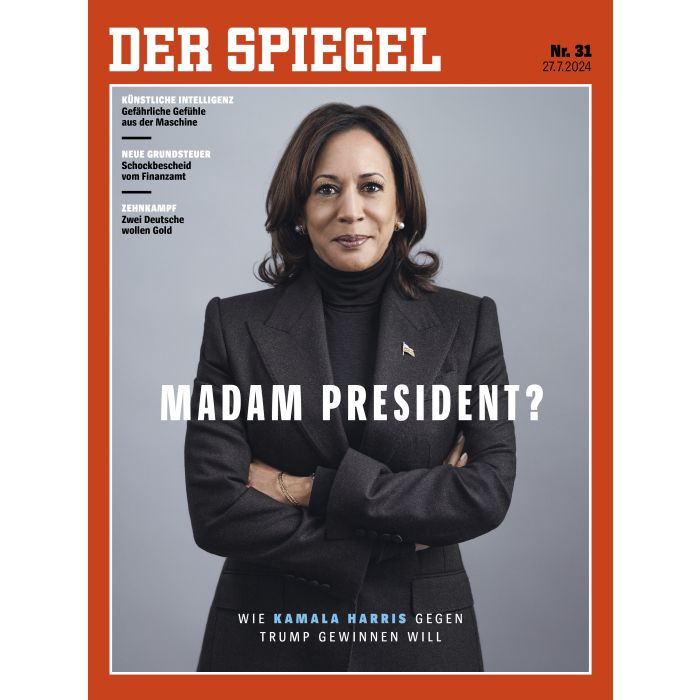
Now, all these things may sound rather baffling to the observant reader, but one of these topics has been especially disturbing: the German media’s hysterical worship of Kamala Harris. Of course, the US presidential election has long been an event of global interest, with wide-reaching consequences. It is only natural that reporting about the candidates’ campaigns and about political developments takes up considerable space in the daily news cycle. What was quite a novelty, though, was witnessing one of the largest German daily newspapers, the left-leaning Süddeutsche Zeitung, putting a stylized image of the Democrat candidate on its frontpage and citing the the Lord’s Prayer in the headline: “Und erlöse uns” (“And deliver us [from evil]”), followed by the no less hysterical: “She is the only one who can still save the world from Donald Trump”. But what may seem bizarre to the US reader, was indeed par for the course in German reporting on the US election. One is hard pressed to find anything even remotely critical of Kamala Harris. For example, the monthly Stern magazine depicted her as the Statue of Liberty, while the notorious Der Spiegel (until recently partially funded by Bill Gates) put her on the cover several times, at one time even with the title “Madam President?”. The nature of this kind of reporting is obvious: it is outright fawning and idolatry.
The monthly Stern magazine depicted Kamala Harris as the Statue of Liberty.
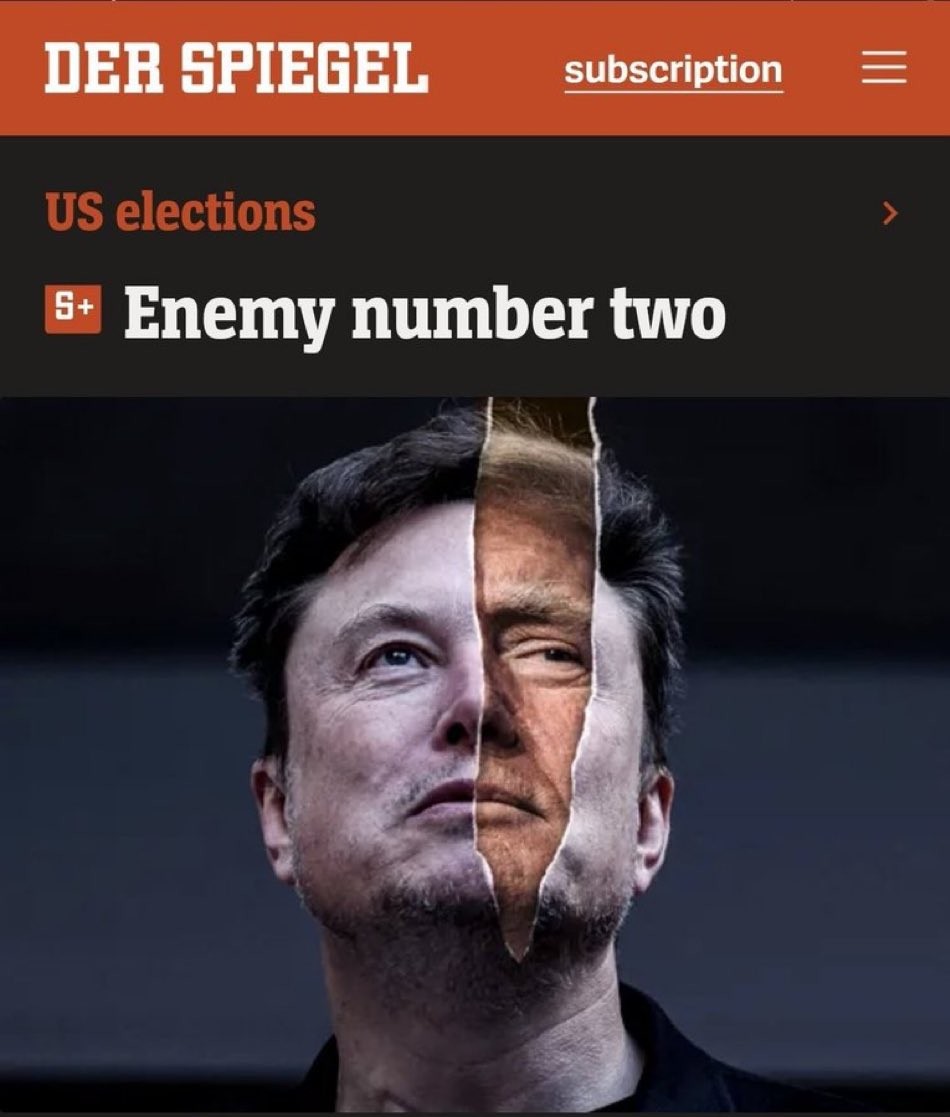
In contrast, Harris’s opponent Donald Trump was both vilified and ridiculed in a re-run of the sheer hatred the now President-elect received back in 2016. Again, Spiegel magazine delivered the goods: the January 2024 edition labelled Trump a “dictator”, continuing an official stance that had gone so far as to depict the then-president with the cut-off head of the Statue of Liberty. The most prominent Trump supporter, Elon Musk, was also chided as “Enemy No. 2” by the Hamburg-based periodical. Documentary-focussed TV channels like public broadcaster ZDF info are showing doc series about the “Trump-Clan”, while the non-fiction corner of book shops is flooded with printed matter about Trump’s business failures or the dubious origins of his wealth. On cable news channels like NTV, serious-looking reporters warned about how Trump, should he lose (and he will!) “won’t accept defeat”, implying violent protest by his supporters, who are usually made out to be angry, gun-wielding, xenophobic troglodytes.
An amusing detail is that the same people who for years forbade any inquiries about the health status of current-president Joe Biden are now obsessed by the alleged “mental and physical instability” of Trump, even paying special interest to the 78-year-old dragging his leg. Some German “comedians” even voiced their regret over the failed assassination attempts on the then-presidential candidate.
Some German “comedians” even voiced their regret over the failed assassination attempts on Trump.
Granted, this was (and still is) the official line of other court stenographers like the New York Times or the Atlantic—or, to be more exact, the general opinion of every liberal outlet. But what’s irritating in Germany is the intensity. The German mainstream media was treating the US election with a zeal only otherwise seen in coverage of their own country’s general elections, while showcasing a one-sidedness that doesn’t even pretend to be objective. Observing all of this, one might want to remind our esteemed journalists that Germany has no say in the outcome of US federal elections. The American voter will always be very unlikely to cast his vote to please the whims of German journalists. Nor will German readers know much about the various criticisms addressed to Harris: her lack of actual policy plans, her “flip-flopping” on various topics like fracking, or her inauthenticity (claiming to be “middle-class”, when she actually grew up in a mansion in a wealthy suburb of Montreal, constant changing of accents, etc.).
The German mainstream media was treating the US election with a zeal only otherwise seen in coverage of their own country’s general elections, while showcasing a one-sidedness that doesn’t even pretend to be objective.
Decisions that proved to be detrimental to Harris’s campaign, like the infamous Fox News interview, were grossly misreported by German media: while the world saw a presidential candidate who could hardly answer a straight question and embarrassingly resorted to blaming Trump for every ill that befalls America today (“Donald Trump has been running for office for 10 years”), German audiences were told of Kamala’s rousing success.
The Role of German State Public Broadcasters
To readers of this magazine, this is not too surprising: In an earlier article here, I commented on the similarities between Kamala Harris and the current German Foreign Secretary, Annalena Baerbock. What both politicians share is something I called “Media Armour”, protection and hype from an ideologically aligned media apparatus. We now have a chance to look at the German arm of that “apparatus” itself, embodied in the public broadcast channels ARD and ZDF (roughly equivalent to BBC One and BBC Two in the UK).
Both ARD and ZDF are in themselves large media corporations spanning everything from television to radio and digital media, with an annual budget of € 8.4 billion. They are funded via the mandated fees imposed by law on the German populace, making Germany’s the most expensive public broadcast system in the world. To give you an idea just how rigorously this system is upheld: refusal to pay the fees can eventually lead to a jail sentence—whether you own a TV or radio or do not. The GEZ (Fee Collection Center) operates on an almost Stasi-like level. How is this possible? Despite claims of “objectivity” and “political independence”, members of the ruling parties are present within the program councils and other parts of the public media system. However, in recent years, the criticisms have gotten louder: the main TV corporations are said to be too untransparent, too partisan (in favour of the left), too expensive. There has been a string of scandals around the misappropriation of funds, staggeringly high wages and pensions for the top positions and an endless parade of left-wing party members posing as “random passers-by” in street interviews. The demands for reform are getting louder, now rising to a point when the legislative branch has begun to listen. Budget cuts are being openly discussed.
Refusal to pay fees to the Public Broadcast Fee Collection Center can eventually lead to a jail sentence—whether you own a TV or radio or do not.
Unsurprisingly, bus stops and other public places in Germany were soon plastered in response with campaign posters declaring the importance of “independent Public Broadcasting for Democracy”. This shines a light on the self-image of the state-sponsored media, and the rest of the mainstream media as well: they see themselves as the “Fourth Estate”, the arbiters of truth and democracy. In that mindset, the glorification of one candidate and vilification of the other is not activism—it is a service to democracy. For the longest time, this worked. But on November 6, 2024, this trend ended with a bang.
Obamarama
The failure of Kamala Harris is the failure of the idea of “Media Armour”. Despite the effort of the media apparatus, the usual celebrity endorsements and massive backing by the likes of Dick and Liz Cheney, the Bill And Melinda Gates Foundation, and other heavy-hitters, the American public remained unimpressed with the current VP. Commentators who view this as a massive rejection of “Wokeness” have a point. In the ensuing hysteria in German media, continuing to riff off classics like “Trump is the new Hitler!”, one quote from a political scientist interviewed on Radio Eins, a public radio station based in Potsdam and Berlin, stood out: he chided Trump for the “cult of personality” around him. Regarding the narcissist tendencies prevalent in the now 47th president, this is not a wrong assessment. And yet, there is a deep irony to such a statement. The “cult of personality” is the central aspect of the “Media Candidate” and has been for a long time. And its inception was not Donald Trump in 2016, but someone who is still held in high regard: Barack Obama in 2008. Those who were there remember the endless barrage of “Hope!” and “Change!”, and Obama idolized as being the biggest pop star of 2007/08, his photogenic face prominent on magazine covers from Time to Rolling Stone. But if you dug deeper to find some substance, not much came up: his policies were vague (“Yes, we can!”) and there was little behind the polished, if juvenile, rhetoric.
Obama’s personal iTunes playlists seemed of more interest to the press than his political objectives. His attributes? He wasn’t George W. Bush, and he had the chance to become the first black president. This attitude didn’t stop after he was elected, with absurdities like his receiving the Nobel Peace Prize, without having anything done to foster world peace (and in fact becoming the Drone-bomber-In-Chief in Libya). No scandal, such as Edward Snowden’s revelations about PRISM or Obama’s disastrous Iran nuclear deal that encouraged the Mullah regime to ramp up its rhetoric against Israel, could ever break the Media Armour around him. Even now, some people still think of Obama as “one of the good guys”, who had a “scandal-free presidency”.
Trump, a businessman, did nothing but adapt himself to this new winning formula. A media criticizing him for that only shows its own hypocrisy and refusal to admit its own part in establishing Media Armour as a legitimate way to gain political power. What must have really hurt is Trump proving he can play the game even better than them. Trump built his own Media Armour, using conservative outlets, and also “alternative media”. This goes to show how vital this element has become in the current political sphere. And whatever one might think of him as a politician and statesman, Trump’s PR stunts, like working a shift at McDonald’s or appearing on Joe Rogan’s podcast, were an act of genius. Kamala Harris appearing on the cover of Vogue, on the other hand, clearly betrayed the class difference in their respective target voters.
I’m Still Robert From the Block
The remaining question is what the media will eventually learn from the Harris disaster. It could be rewarding to keep an eye on Germany, since Robert Habeck has declared his intention to run for the chancellorship in the upcoming federal re-election, now brought forward from September to February of 2025. This happened right after the breakup of the current German government that coincided with the US presidential elections [article in Café Américain forthcoming]. Habeck made his intentions public by returning to X and posting a guy-next-door vibe video, casually sitting, as he explains, “in some friends’ kitchen” with the refrigerator (children’s drawings and holiday postcards tagged to it) in the background, and offering his prospective voters a chance to talk freely in his typical “empathic” social worker’s voice. All the while, however, he openly calls for the governmental regulation of Social Media platforms like X and for the persecution of everyone who voices their dissent with his views. Habeck, the darling of most mainstream journalists, will undoubtedly become the next big German media candidate, possibly backed even more than his colleague Baerbock when she ran for the chancellorship in 2021. One thing should be noted: the approval ratings for Habeck’s Green Party are at a historical low, at around 10%. It will be an interesting spectacle to watch. It might even be the end of the world, as the media knows it, and I feel fine.