The claim that Zionism is a form of colonialism is at the heart of a lot of anti-Zionist narratives. The story goes that white, Western Jews decided to colonize Palestine and displace the native Palestinian Arab population.
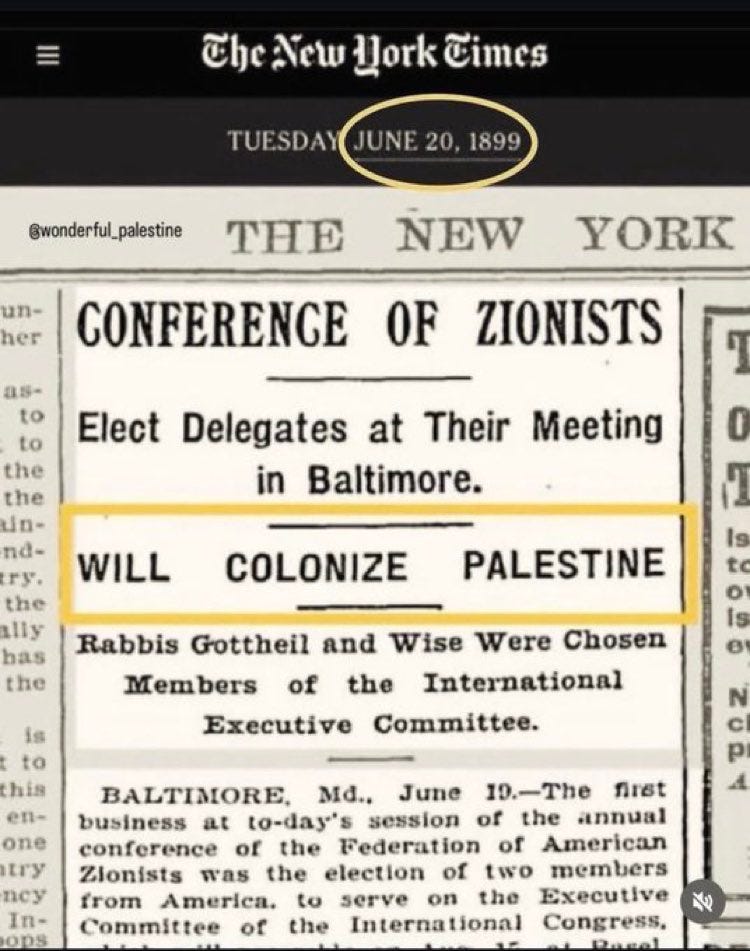
One piece of historical evidence that often gets thrown around in these conversations and seems to have gone mega viral a few times recently is this headline from the New York Times, proclaiming that Zionists intended to colonize Palestine:

The implication of this accusation of colonization is that colonization is a horrible thing that must end as the arc of history bends further and further towards justice, to paraphrase Martin Luther King, Jr. In other words, the colonizers must give the land back to the previous owners, and return from whence they came.
But ownership of land, especially in a national sense, is a complex and fraught topic. Yes, it’s true that Palestinian Arabs were living in the land as a majority during the British Mandate between 1917-1947, and within the Ottoman Empire for four hundred years before that. But there were multiple earlier Jewish polities in the Holy Land across history, with the most recent independent Jewish entity ending with the defeat of the Bar Kokhba revolt in 136 AD, after the destruction of the Second Temple in 70 AD following the first Jewish-Roman war.
The result of the Roman colonization of the land was the enslavement and expulsion of much of the pre-existing indigenous Jewish population, who became scattered across the former Roman empire in Europe and the Middle East. But the ancestors of the Palestinians are not only later Arab conquerors, and the Romans and Byzantines themselves. Palestinians are also descended in large part from remnants of the Jewish population that stayed on the land in spite of Roman rule, and later converted to Christianity or Islam.
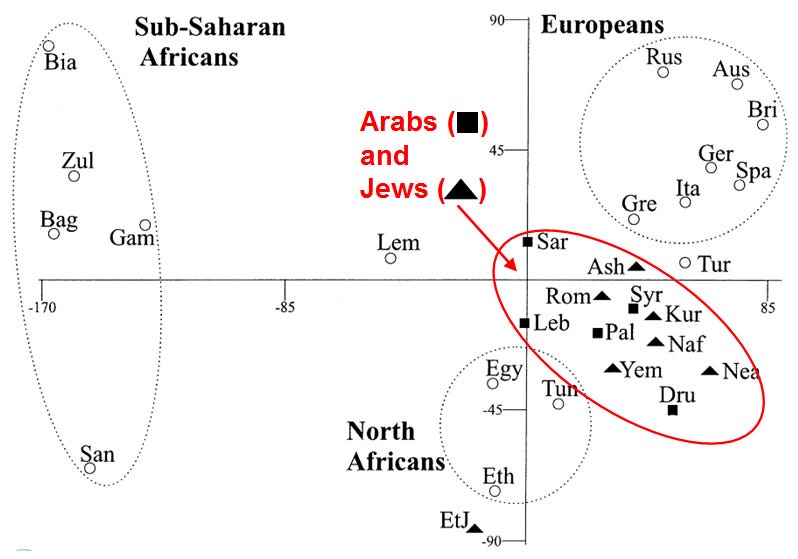
This is why Jewish and Palestinian populations are genetically quite closely linked:

The reality of Zionism is that it was the descendants of Jewish people who had previously been displaced from Palestine (or the Land of Israel, or whatever you want to call it) trying to return to the homeland of their ancestors.
This is why, unlike with classical colonialism, for example the French colonization of Algeria—which is often cited as an inspiration by Palestinian anti-Zionists—there is no mother country or colonial metropole in the case of Zionism. Colonialism is defined in the Oxford English Dictionary as the act of one country acquiring control over another country, occupying it with settlers, and exploiting it economically.
Now some may contest this definition. But by that definition, the New York Times description of Zionism as an act of colonisation was simply not accurate.
The question to ask anyone who claims Zionism is colonialism is what is the mother country?
Some anti-Zionists try to claim that the Balfour declaration and British acceptance of Jewish migration to Palestine were acts of colonialism, meaning that the mother country in this sense is the UK. But Israelis with a few individual exceptions are not British unless they have some specific tie to the UK, for example if their parents were British citizens. The Balfour declaration was simply a statement that the UK accepted the historical claim of Jewish self-determination in the land, with the caveat that this did not prejudice the rights of the non-Jewish (i.e. Palestinian Arab) inhabitants.
In other words, it was a decolonial document setting out a vision for the end of colonial rule. The creation of Israel was actually an act of decolonization, where the British colonial authorities left the land, and the people of the land became independent, at least in Israel. The people of the West Bank and Gaza, of course, did not become independent, because they instead were occupied by their fellow Arabs in the form of the armies of Egypt in the case of Gaza, and Jordan in the case of the West Bank. But they too were no longer under British rule.
Other anti-Zionists will try to claim that the mother country is Poland, and Ukraine, and America, and all of the places from which Israeli Jews migrated to Palestine. But the Jewish migrants considered themselves to be returning home by migrating to Palestine. They were not thinking of themselves as colonizing the land on behalf of Poland, Ukraine, or Russia, or America. By contrast, there were many persecutions of Jewish people in these places, leading up to the Holocaust. They were not Polish colonists so much as Polish escapees. And of course, Moroccan escapees, Algerian escapees, Yemeni escapees, Iraqi escapees. For most of the Jewish people in the Middle East also ended up fleeing to Israel.
What has really taken place, as I described in Quillette recently, is a tragic and horrifying clash between cousins and a conflict of differing national ideologies.
Yes, the Jewish people who made up the bulk of the early Israeli population were in many cases recent immigrants. But their presence in the land was a direct consequence of their ancestors’ inhabitation of the land before their scattering by the Roman Empire. This is why the Zionist movement chose Palestine, and not Argentina, Madagascar, or some remote location in America.
Now, obviously, no Palestinian including me is happy with the status quo in the land, or the military rule in the West Bank, or the war in Gaza. Palestinians are deeply traumatized and wounded by the current reality on the ground. Having to pass through multiple military checkpoints to get home from work or school every day, or to get to the hospital, or to visit your family is an utter nightmare. Nobody would want to live like that, and I would not wish this on my worst enemy. Palestinians need a real solution to make their lives better, to address their displacement, and the awful circumstances that they face in many cases.
We urgently need a resolution to the conflict, one that would recognise the national and individual rights of both Zionists, and Palestinian Arabs.
But characterizing this conflict as colonization of Palestine by Israel is just not an accurate description.
My fear is that this dishonesty around its nature will simply perpetuate and exacerbate the conflict. If the proposed solution to the so-called colonization of Palestine by Zionists is for Israel to be dismantled, and the Jewish Israelis to be deported to wherever their ancestors migrated from, then the conflict is insoluble. Jewish Israelis will never accept this, because it is simply a repeat of what was imposed on their ancestors unjustly by the Roman Empire. They would resist such a policy as fiercely as Palestinians would resist their relocation to Libya or Saudi Arabia.
I don’t expect peace and a resolution to the conflict will happen any time soon. But I commit wholeheartedly to trying to understand the underlying fractures between the Jewish and Palestinian people, and doing my best to bring an end to the conflict as soon as possible.
This essay was originally published on the author’s Substack.